01The Autonomous Workforce Has Arrived
Generative AI answered questions. Agentic AI takes actions. Modern agents read inboxes, query databases, call APIs, move files, execute code, and chain those steps together toward goals — often with minimal human review of any individual action. That shift changes the security question fundamentally: the risk is no longer just what a model might say, but what an autonomous system might do with the credentials and connections it has been handed.
The concern is no longer theoretical. Security leaders now rank AI-related vulnerabilities among the fastest-growing risks they face, and analysts project that a large share of organizations will suffer a security or compliance incident tied to unsanctioned AI use within the next few years. Securing agentic AI means treating every agent as what it actually is: a new class of privileged, non-human worker operating at machine speed.
02Shadow AI and Ungoverned Agents: An Emerging Attack Surface
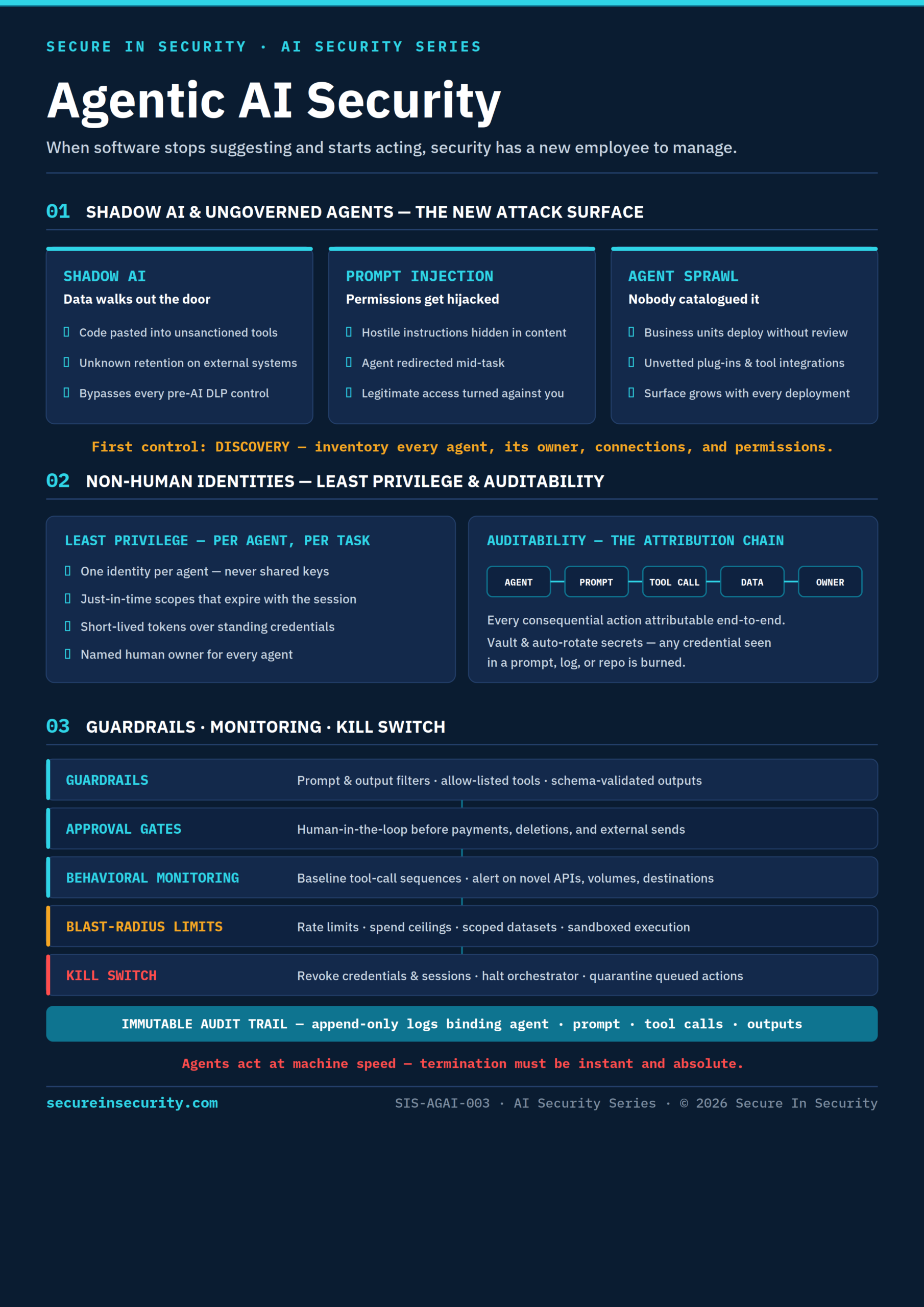
Shadow AI
Data walks out the door
Unsanctioned tools, unknown retention, and every pre-AI DLP control bypassed.
Prompt Injection
Permissions get hijacked
Hostile instructions hidden in content redirect an agent mid-task.
Agent Sprawl
Nobody catalogued it
Unreviewed deployments and unvetted plug-ins expand the surface daily.
Shadow AI is shadow IT with a copy of your data. Employees paste source code, customer records, and strategy documents into unsanctioned AI tools daily — each paste an uncontrolled data transfer to an external system with unknown retention. Browser extensions and personal accounts bypass every data loss prevention control built for the pre-AI enterprise.
Ungoverned agents raise the stakes from leakage to action. An agent wired to email, storage, and internal APIs — deployed by a business unit without security review — is a standing capability that anyone who can influence its inputs can potentially direct. Prompt injection makes that influence practical: hostile instructions hidden in a webpage, document, or email can hijack an agent mid-task, turning its legitimate permissions into an attacker toolset. Add compromised third-party tool integrations and unvetted plug-ins to the supply chain, and agent sprawl becomes an attack surface that expands with every new deployment nobody catalogued.
The first control is discovery. You cannot govern what you have not found: inventory sanctioned and unsanctioned AI use, catalog every agent with its owner, connections, and permissions, and route new deployments through a lightweight review path — so the safe road is also the fast one.
03Least Privilege and Auditability for Non-Human Identities
Non-human identities — service accounts, API keys, and now agents — already outnumber human identities in most cloud estates by an order of magnitude. Agents inherit every classic NHI weakness: over-broad scopes, credentials that never rotate, and no clear owner. They add a new one: their behavior is dynamic, shaped by prompts and context rather than fixed code paths.
Least privilege must become per-agent and per-task. Every agent needs its own identity — never a shared key — with permissions scoped to the specific task, granted just-in-time, and expiring with the session. Short-lived tokens beat standing credentials; scoped datasets beat blanket read access; a named human owner beats an orphaned service principal. Vault and rotate agent secrets automatically, and treat any credential that appears in a prompt, log, or repository as burned.
Auditability is the other half of the contract. Every consequential action an agent takes should be attributable end-to-end:
Which agent, acting on which prompt, invoked which tool, touching which data, on whose behalf. Without that chain, incident response degenerates into guesswork — and compliance obligations become impossible to demonstrate.
04Guardrails, Monitoring, and Kill-Switch Patterns for Agent Workflows
Agent security is engineered in layers. Guardrails constrain the workflow before anything executes, monitoring watches it while it runs, and kill switches end it the moment it goes wrong. The patterns below form a practical baseline. Red-team the workflow as well: adversarial prompt-injection testing before deployment finds the failure modes attackers will otherwise find after it.
| Pattern | Purpose | Example Implementation |
|---|---|---|
| Guardrails | Constrain what agents can say, retrieve, and do at the input and output boundary | Prompt and response filters, allow-listed tools, schema-validated outputs |
| Approval gates | Insert a human before irreversible or high-impact actions | Human-in-the-loop sign-off for payments, deletions, and external sends |
| Behavioral monitoring | Detect agents drifting from expected patterns in real time | Baseline tool-call sequences; alert on novel APIs, volumes, or destinations |
| Blast-radius limits | Cap the damage any single agent run can cause | Rate limits, spend ceilings, scoped datasets, sandboxed execution |
| Kill switch | Terminate a misbehaving agent instantly and completely | Revoke credentials and sessions, circuit-breaker on the orchestrator |
| Immutable audit trail | Reconstruct every action, decision, and data touch after the fact | Append-only logs binding agent identity, prompt, tool calls, and outputs |
The kill switch deserves special emphasis. Because agents operate at machine speed, a misbehaving workflow can execute hundreds of actions in the time a human takes to read one alert. Termination must be equally fast and absolute: revoke the agent’s credentials and active sessions, halt the orchestrator, and quarantine any queued actions — then use the audit trail to determine what actually happened.
05The Bottom Line
Agentic AI hands software real permissions, real credentials, and real consequences. Treat every agent like the privileged employee it is: inventory it so nothing runs in shadow, scope its access to the task at hand, log everything it touches, wrap its workflow in guardrails and monitoring, and keep a kill switch within reach at all times. Organizations that govern agents from day one gain the productivity without inheriting the breach. The ones that do not will discover that their newest, fastest worker never signed the security policy.
Key Takeaway
Agents act at machine speed — governance must too. One identity per agent, permissions per task, an audit trail for everything, and a kill switch that is instant and absolute.